Farm and agricultural restrooms in Ventura start at a standard porta potty running $100 to $350 a day, and OSHA 1928.110 sets the baseline: one facility per 20 hand-labor employees, reachable within a quarter mile walk. Ventura Porta Pros services strawberry fields, citrus groves and ranch operations across the county with that standard in mind.
Start with your crew count and work backward from OSHA 1928.110, which requires potable water, toilets and handwashing within a quarter mile walk for hand-labor employees, at a ratio of one facility per 20 workers. A 40-person picking crew spread across a Ventura strawberry field needs at least two units, positioned so nobody has to walk further than that quarter mile between rows. Construction crews follow a different rule: OSHA 1926.51(c) sets one toilet for 20 workers or fewer, then scales up as headcount grows. Farms are not construction sites, so 1928.110 is the one that applies here, and it is stricter about walking distance than it is about raw ratios. Ventura Porta Pros maps unit placement against field layout, not just worker count, because a unit at the wrong end of a 40-acre parcel does nobody any good. Use the porta potty placement guide to think through row spacing, prevailing wind and truck access before delivery day. For larger seasonal crews, the how many porta potties do I need calculator handles the math faster than doing it by hand. Standard units run $130 to $500 a week depending on service frequency, and a standard porta potty rental is the right fit for most row-crop and orchard work. Ranches with a fixed crew location for the season often do better with a monthly porta potty rental instead of restarting a weekly order every few weeks.
Field sanitation calls for potable water and handwashing that's separate from the toilet unit itself, per OSHA 1928.110, and 29 CFR 1910.141(d)(2) requires soap and a towel or drying device -- hand sanitizer alone does not satisfy either rule. This matters more on farms than almost anywhere else, because harvest crews are handling produce right after using the facilities. A handwashing station rental paired with each toilet cluster covers the requirement cleanly. If your crew is doing any spraying work -- pesticides, herbicides, or coating application on equipment -- OSHA 1926.51(f)(1) kicks in separately and requires washing facilities specifically for that contaminant exposure, on top of the general field sanitation rule. Don't confuse the two: 1928.110 covers the crew generally, 1926.51(f)(1) covers anyone handling chemicals. A portable sink rental with a soap dispenser and paper towels satisfies both. Some operations lean on a hand sanitizer station rental as a supplement between wash breaks, which is fine as an add-on but never as the sole handwashing setup near sprayed fields. Ventura Porta Pros delivers handwashing units alongside toilets on the same route, so there's one delivery window instead of two separate coordination headaches during a tight harvest schedule.
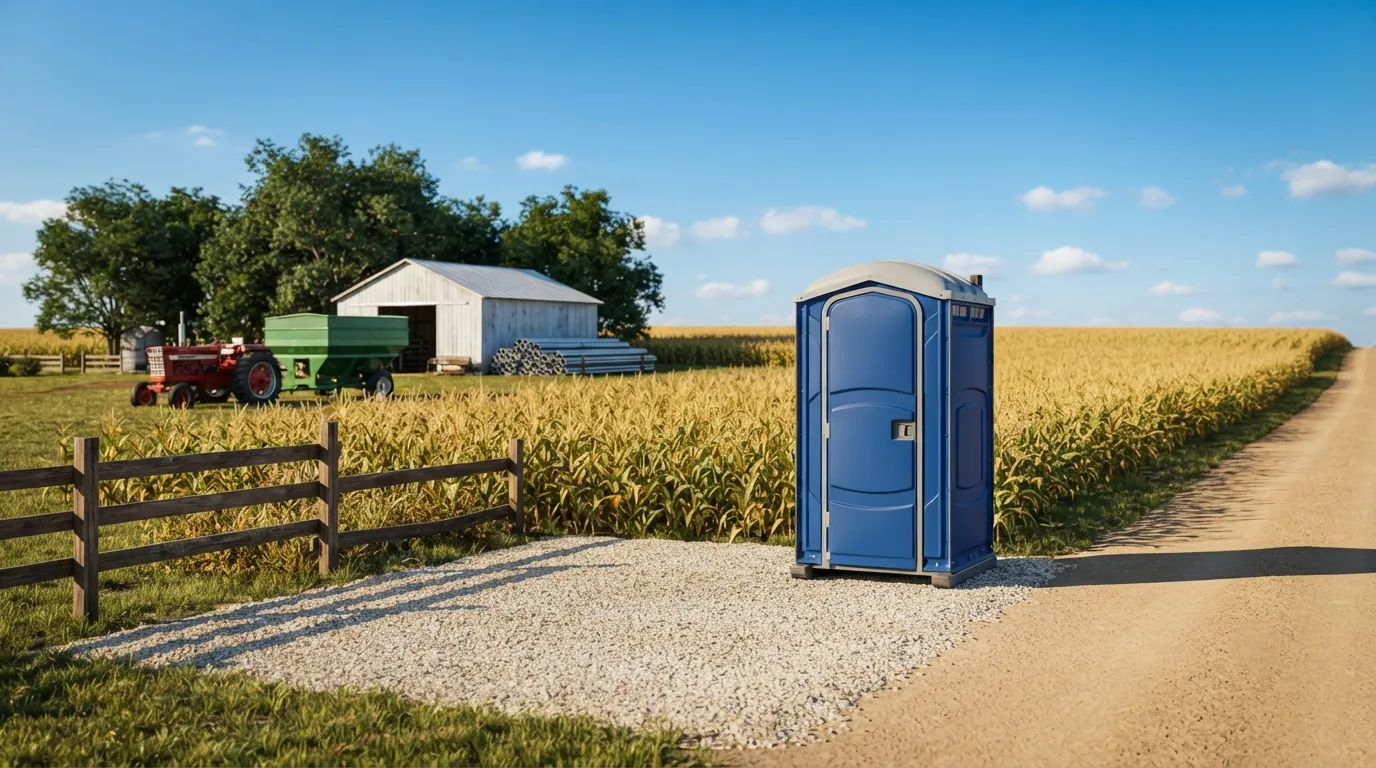
Placement matters more on a farm than on a flat construction pad, because ground conditions and irrigation lines change week to week. Units need level, stable ground -- the same firm, slip-resistant surface standard referenced in ADA Standards 302.1 applies just as much to a gravel turnout as it does to a job site path. A standard unit sits about 44 by 48 inches on the ground and stands roughly 92 inches tall, small enough to tuck at a field edge without eating into planted rows. Access matters too: delivery trucks need a clear path in, and if you're bringing in a roll-off for equipment debris or end-of-season cleanup, plan on roughly 60 feet of straight clearance behind the truck for that drop. Farms near Ventura's edge -- out toward Saticoy, about 7.4 miles east, or El Rio, 7.3 miles east -- often run multiple parcels under one account, and Ventura Porta Pros can stage units across sites on a single delivery run. If workers include anyone using a wheelchair or mobility device, ADA Standards 213.2 requires at least one accessible unit in any cluster, and an ADA accessible porta potty has a 60 inch turning circle inside per ADA 304.3.1. For operations near Santa Paula, 13.6 miles northeast, or further out toward Moorpark at 24.2 miles east, check the service areas page for routing before harvest season locks in your calendar.
ANSI/PSAI Z4.3 sets a baseline of one service visit per week for up to 10 users over a 40-hour week, but larger crews need more frequent pumping. Ventura Porta Pros adjusts the schedule to crew size and season. See how often are porta potties cleaned for the full breakdown.
Placement on private agricultural land is usually straightforward, but anything near a public right of way needs confirming with the city. Check porta potty permit requirements before finalizing a site plan, especially for roadside stands or U-pick operations.
A standard unit runs $100 to $350 a day or $130 to $500 a week depending on service frequency and crew size. Full pricing detail, including delivery fees, is on the porta potty rental cost page.
Yes, for wash stations or livestock operations needing wastewater capture. A holding tank rental works alongside standard units for farms with equipment washdown needs.
Residential septic tanks typically need pumping every 3 to 5 years depending on tank size and household count. See septic pumping service or how often to pump a septic tank for scheduling guidance.
Yes. Ventura Porta Pros delivers farm and agricultural restrooms across Ventura and the surrounding metro, with same-day and next-day drop-off available on most orders.
Pricing depends on the unit and how long you need it. See our cost breakdown and request a free quote for an exact figure.
Standard rentals include scheduled service — a pump-out, a clean, a restock and fresh deodorizer. Busy or hot-weather sites can be serviced more often.
Call now or request a free quote — clean units, on-time delivery, transparent pricing.